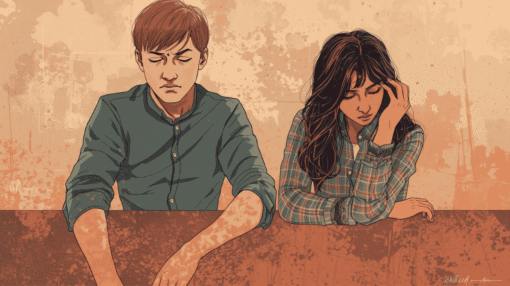
The Moment Everything Changed
You’re sitting across from them at dinner. They’re telling you about their day—the project they worked on, the effort it took, how much it matters to them. And you hear yourself say, “That’s great. I’m proud of you.”
But inside? Nothing feels right.
The words come out because they should. Because you know this person has been working harder than ever. Because you’re trying to be a good partner. But there’s a hollow space between the words and your heart—and they probably feel it too.
This isn’t laziness or lack of caring. This is what happens after betrayal, after emotional distance, after resentment has built walls between you and someone you once trusted completely.
You want to feel that genuine appreciation. The kind that flows naturally, that makes your chest warm, that doesn’t require effort. But instead, you feel like you’re performing gratitude while protecting yourself from being hurt again.
This is the core wound that most relationship advice misses entirely.

The Quick Truth: What You Need to Know Right Now
Genuine appreciation is impossible while you’re emotionally protecting yourself from someone. You can perform appreciation as a behavior—saying thank you, acknowledging effort, showing gratitude—but authentic appreciation requires vulnerability. And vulnerability feels dangerous when trust has been broken.
The path to real appreciation isn’t “try harder to appreciate them.” It’s healing the betrayal wound first, then letting authentic appreciation emerge naturally as a result.
The Problem Most People Don’t See
Every relationship article tells you the same thing: Be appreciative. Express gratitude. Make them feel valued.
And if you could do that, you would.
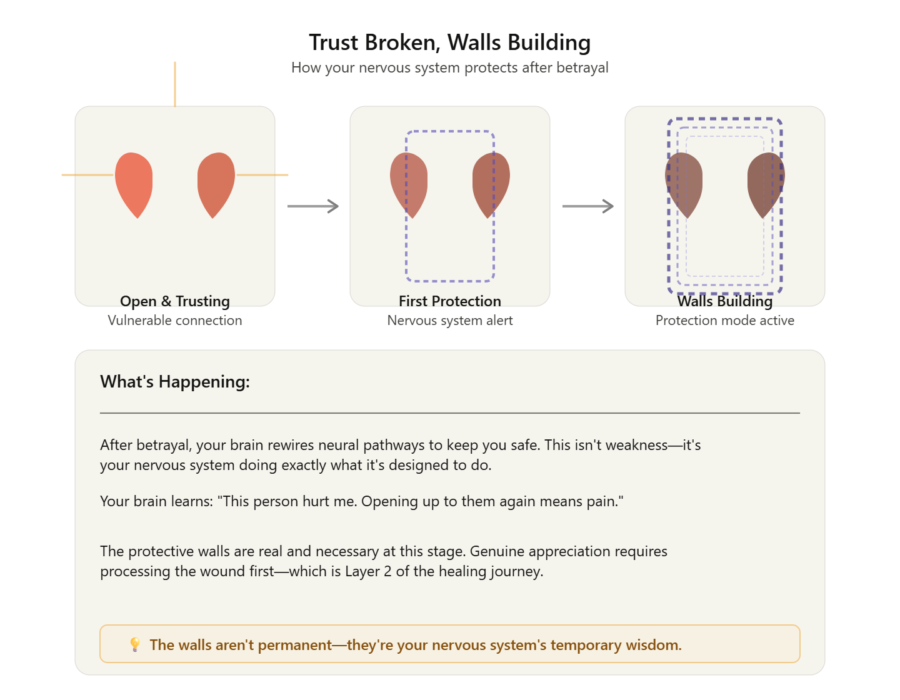
But here’s what these articles miss: You cannot genuinely appreciate someone while your nervous system is in protection mode. When betrayal happens—whether it’s emotional infidelity, broken promises, dishonesty, or simple emotional abandonment—your brain literally rewires how it responds to that person.
Research in neuroscience shows that after someone violates your trust, your brain creates new neural pathways designed to keep you safe. These pathways make genuine vulnerability feel dangerous. So when you try to appreciate them—to let your guard down—your nervous system sends a warning signal: This isn’t safe. Don’t open up.
You’re not being ungrateful. You’re being neurologically protective.
According to another [neuroscience research], this isn’t just emotional—betrayal activates the same brain regions as physical pain. The insula and anterior cingulate cortex (your brain’s “moral compass”) light up both as cognitive dissonance and as actual physical pain. This is why survivors describe their hurt as “visceral” and why phrases like “my heart is broken” are neurobiological reality, not just metaphor.
The resentment you feel isn’t laziness or a choice—it’s often grief. Grief over the person you thought they were. Grief over the relationship you believed you had. And that grief needs to be processed before appreciation can actually flow.
Understanding the Four Layers of Authentic Appreciation
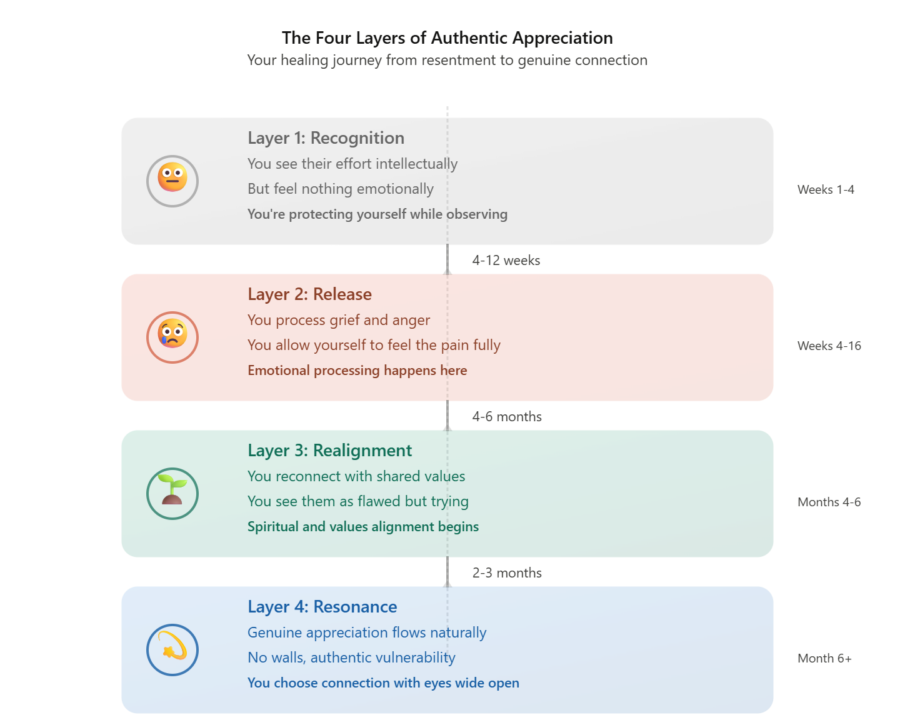
This is where most healing attempts go wrong. People skip the necessary layers and try to jump straight to the gratitude and performance—which is why it never feels real.
Here’s the framework that changes everything:
Layer 1: Recognition (Still Resentful)
This is where you are right now. You see their effort. You recognize it intellectually. They’re working hard. They’re trying. You can acknowledge these facts.
But emotionally? Nothing lands. Their hard work doesn’t move you because you’re still in self-protection. Your appreciation feels hollow because it has to navigate through walls of hurt and caution.
What’s happening underneath: Your nervous system is saying, “I see the effort, but I don’t trust the intention. I’m protecting myself because I’ve been hurt before.”
This layer often feels like performance. You say the right things. You do the right things. You look like you appreciate them. But there’s a distance inside that no words can bridge yet.
Common experience: You congratulate them on an achievement, but inside you feel: That’s nice, but what about when you hurt me? Does that effort count?
Layer 2: Release (Emotional Processing)
This is where the real work happens. And this is where most people get stuck, trying to move past it too quickly.
In this layer, you consciously choose to process the betrayal instead of just storing it. You grieve what was lost. You allow yourself to feel the anger, the hurt, the disappointment—fully and completely.
This isn’t about forgiving them yet. This is about accepting that the hurt happened and that it changed you.
You might:
- Write about the betrayal in a journal (processing emotions through structured journaling helps tremendously here)
- Allow yourself to feel rage without acting on it
- Acknowledge the gap between who you thought they were and who they actually are
- Grieve the relationship you believed you had
What’s happening underneath: Your nervous system is beginning to distinguish between past hurt and present moment. You’re saying to yourself: “This happened. It was painful. And I survived it.”
The spiritual element: Many spiritual traditions teach that forgiveness can’t happen until you’ve fully felt and acknowledged the wound. You’re not skipping to forgiveness—you’re doing the necessary grieving first.
Common experience: You find yourself crying while doing the dishes. You feel rage when you hear their keys at the door. These aren’t signs of failure—they’re signs that the emotional processing is happening.
Layer 3: Realignment (Spiritual Reconnection)
Once you’ve processed the grief, something shifts. You’re no longer in fight-or-flight about this person. You can see them more clearly—not as the person who hurt you, but as a flawed human being who also gets hurt, who also struggles, who also is trying in their own imperfect way.
In this layer, you reconnect with the spiritual or values-based reasons you were with them in the first place.
Maybe it was:
- Shared spiritual beliefs or practices
- Aligned values about what matters in life
- Genuine connection at a deeper level
- The person they aspire to be (even if they’re not there yet)
- Your shared purpose or vision
You’re not denying the betrayal. You’re not pretending it didn’t happen. You’re consciously choosing to see beyond the betrayal to the deeper connection.
What’s happening underneath: Your nervous system is learning that this person can be both “someone who hurt me” AND “someone I care about.” These don’t have to be mutually exclusive.
This is where appreciation begins to shift from performance to authenticity. Because you’re no longer just seeing their effort—you’re seeing their effort through the lens of shared values and spiritual alignment.
The psychological element: This is attachment theory working in real-time. After processing the hurt, your brain can begin to rebuild the secure attachment that was broken.
Common experience: You notice something they do and instead of thinking, That’s nice but… you think, That’s so them. That’s the part of them I loved. There’s a softening happening.
Layer 4: Resonance (Genuine Appreciation)
This is the destination that most people are trying to force before they’re ready.
In this layer, appreciation flows naturally. Not because you’re trying. Not because you should. But because you’ve healed the wound enough that vulnerability feels safe again.
You can genuinely celebrate their wins. You can feel proud of their effort. You can express gratitude without it feeling hollow. Not because they’ve become a different person, but because you’ve processed your hurt enough that you can see them clearly again—flaws and all—and still choose connection.
What’s happening underneath: Your nervous system has integrated the betrayal into your story, but it’s no longer running your present moment. You can be vulnerable with this person again because you’ve learned that you can survive disappointment.
The spiritual element: This is what spiritual traditions call “unconditional love”—not pretending someone didn’t hurt you, but loving them despite their flaws. Loving the person they’re becoming, not just the person they are.
This appreciation is often deeper than what existed before, because it’s been earned through genuine processing rather than assumed.
Common experience: You feel genuine warmth when they walk in the room. Their effort moves you. You can express appreciation without walls. And if they hurt you again, you’ll know how to process it—not because you’re cynical, but because you’ve learned the path.
How This Shows Up in Real Life
The Story of Sarah & Marcus
Sarah came to me after 8 months of emotional distance from Marcus. He hadn’t been unfaithful, but he’d lied about something important—where he spent time, who he was with. Nothing explicitly “wrong,” but enough to crack the trust.
She told me: “I know he’s a good person. I know he works hard. I know he loves me. But when he talks about his accomplishments, I just feel… nothing. And then I feel guilty for feeling nothing.”
Layer 1: Sarah was stuck here. She was performing appreciation beautifully—his family thought she was supportive, he thought she cared about his work. But there was no resonance inside her.
Over the next few weeks, we worked through her feelings. She journaled about what the betrayal meant to her. She allowed herself to feel angry—not at him, but at the situation. She grieved the relationship she thought she had, the trust she thought was unbreakable.
Layer 2: This is when things got messier. She cried more. She had moments of rage. But something important was happening: she was processing the actual hurt instead of just performing around it.
Layer 3: About 4 months in, something shifted. She started seeing Marcus’s workaholism differently. Instead of seeing it as avoidance (which was part of it), she also saw it as his way of showing care for their family. She started understanding his values more deeply. She even started a practice of “shared vision journaling”—using prompts to reconnect on what mattered most to both of them.
Layer 4: About 6 months in, she told me: “I was watching him work on the deck we’re building, and I just felt this genuine pride. Not forced. Not because I should. Just… real.”
The appreciation wasn’t conditional on him being perfect. It was genuine because she’d done the work to heal.
The Psychological Foundation: Why This Happens
Sue Johnson, the developer of Emotionally Focused Therapy, describes what happens after betrayal this way: When trust is broken, the brain literally changes how it processes safety signals from that person. Your partner’s closeness, which once felt safe, now triggers alarm bells. Your nervous system has learned that this person can hurt you.
This isn’t weakness. This is wisdom. Your brain is trying to protect you.
But here’s the paradox: Appreciation requires the very vulnerability that feels dangerous. When you genuinely appreciate someone, you’re letting your guard down. You’re saying, “Your effort matters to me. You matter to me.” That’s vulnerable. That’s exactly what your nervous system learned to fear.
So the walls go up. And appreciation becomes performance.
The healing happens when you process the betrayal in a way that lets your nervous system learn: This person hurt me, AND I survived. This person can hurt me, AND I can handle it. This person is flawed, AND I can still choose connection.
This is neuroplasticity in real time. Your brain is literally creating new pathways that can hold both truths at once.
The Spiritual Truth: Appreciation as Surrender
Rumi wrote: “The wound is the place where the Light enters you.”
What Rumi understood is that genuine appreciation requires surrender. Not surrender of your boundaries or your self. Surrender of the story that this person owes you perfection. Surrender of the belief that betrayal means they’re irredeemable. Surrender of the need to stay protected forever.
This is what spiritual traditions mean by “forgiveness”—not excusing what they did, but releasing your grip on the story of what they did.
In many spiritual practices, appreciation is seen as a form of spiritual alignment. When you genuinely appreciate someone’s effort, you’re acknowledging their soul’s attempt to grow, even when they’re failing. You’re seeing the sacred in their struggle.
This doesn’t make the betrayal okay. It just means you’re choosing to see beyond the betrayal.
The Healing Journey: What Each Stage Really Requires
Stage 1: Recognition (Weeks 1-4)
What’s happening: You’re seeing the effort, but emotional walls are in place.
What to do:
- Don’t force appreciation. Acknowledge what you observe without judgment.
- “I see you’re working hard” is enough. You don’t need to feel something you don’t feel yet.
- Notice where resentment lives in your body. Where do you feel it?
- Start a simple practice: each night, write down one thing you observed them do (not how it made you feel, just what you saw).
Common pitfall: Trying to feel appreciation before you’ve processed the hurt. This creates more inauthenticity, not less.
Mindset shift: “I’m not broken for not feeling appreciation yet. I’m protecting myself, and that makes sense.”
Stage 2: Release (Weeks 4-16)
What’s happening: You’re processing the betrayal fully. This is often the most painful stage, and that’s okay.
What to do:
- Allow yourself to feel the full range of emotions. Anger, grief, disappointment, rage—let them move through you.
- Use structured journaling to process complex emotions without judgment. Ask yourself: What did I lose when this happened? What about me does this threaten?
- Have conversations (if safe) about what the betrayal meant to you. Not to blame them, but to be heard.
- Consider a spiritual practice—meditation, prayer, or intentional reflection—that helps you process what happened as part of your spiritual journey.
Common pitfall: Thinking you should “move on” from this stage quickly. Grief needs time. Give it the time it needs.
Mindset shift: “I’m grieving what I lost. This is necessary. This is how I heal.”
Stage 3: Realignment (Weeks 16-24)
What’s happening: You’re beginning to see this person and this relationship with fresh eyes. You’re reconnecting with deeper values and purpose.
What to do:
- Ask yourself: What spiritual or values-based connection drew me to this person initially?
- Journal about where you see growth in them (even small growth). Not to excuse the betrayal, but to acknowledge their humanity.
- Have conversations about shared values, shared vision, shared purpose. What do you both care about?
- Practice seeing them through the lens of their intentions, not just their actions. What are they trying to do, even when they’re failing?
Common pitfall: Skipping the grief and jumping here too quickly. This stage only works if you’ve genuinely processed the hurt.
Mindset shift: “I’m learning to hold complexity. They can be flawed AND be trying. They can have hurt me AND be worthy of a second chance.”
Stage 4: Resonance (Month 6+)
What’s happening: Genuine appreciation is beginning to flow naturally. Not as performance, but as authentic response.
What to do:
- Continue the practices from Stage 3 (values alignment, noticing growth).
- Express appreciation without expectation. “I noticed you did X, and it mattered to me” (not “you should do this more”).
- Build new traditions or practices that reinforce the realignment. Maybe shared spiritual practices, shared goal-setting, shared reflection.
- Know that this stage isn’t about perfection. You’ll still get hurt sometimes. But now you know the path through it.
Common pitfall: Thinking this stage is the end. It’s not. It’s a new beginning that requires ongoing practice.
Mindset shift: “Genuine appreciation means I can see them clearly—flaws and all—and choose connection anyway.”
Integration & Daily Practice: Living This Long-Term
This isn’t about one-time healing. It’s about building sustainable practices that keep you connected to authentic appreciation even when things get hard again.
Daily practices:
- Morning intention: What shared value or purpose do I want to remember today?
- Observation without judgment: Notice one thing they did today (action, not feeling).
- Gratitude that’s specific: Instead of “I’m grateful for him,” try “I’m grateful for how he showed up for me in this specific way.”
- Spiritual connection: Whether it’s prayer, meditation, or reflection—maintain your own spiritual practice so you’re not dependent on them for spiritual fulfillment.
Weekly practices:
- Check in with yourself: Which layer am I in right now? (Be honest—we can move between layers depending on what’s happening.)
- Share appreciation genuinely: “I want you to know that I genuinely appreciated how you handled X. Here’s why it mattered to me.”
- Realign on values: “What do we want to be true of us as a couple this week?”
The permission you need: You will sometimes slip back into protection mode. That’s not failure. That’s normal. The difference is that now you know the path through it.
What People Get Wrong About Appreciation After Betrayal
Myth #1: “If I still love them, I shouldn’t need to process the betrayal.”
The truth: Love doesn’t erase hurt. You can love someone deeply AND be wounded by them. Processing the wound isn’t a sign that you don’t love them enough. It’s a sign that you love yourself enough to honor what happened to you.
Myth #2: “Appreciation means forgiveness means pretending it didn’t happen.”
The truth: Forgiveness doesn’t erase the past. It means you stop letting the past control your present. You can genuinely appreciate someone while also acknowledging that they hurt you and that hurt changed you.
Myth #3: “Real appreciation should happen instantly.”
The truth: Real appreciation takes time, especially after betrayal. There’s no timeline you should hit. Your healing is your own pace.
Myth #4: “If I’m not appreciating them, I must not love them anymore.”
The truth: You might love them. You might also be hurt and in protection mode. Both can be true. Processing the hurt is how you get back to authentic love.
Real Stories of Transformation
James’s Journey
James had been with his partner for 12 years when he discovered that emotional distance had become the norm. His partner was working intensely on a career transition, and James felt abandoned in the process.
He found himself doing all the right things—cooking dinner, asking about the work, being supportive—but feeling empty inside.
“I realized I wasn’t just unsupported. I was resentful that they got to pursue their dreams while I was managing everything else,” he shared.
Through the four layers, James:
- Layer 1: Acknowledged the work his partner was doing, while sitting with his resentment.
- Layer 2: Processed his grief over not feeling important, not feeling seen.
- Layer 3: Reconnected with why they’d come together—shared ambition, shared values about growth—and realized they both wanted growth, just different kinds.
- Layer 4: Genuine appreciation emerged when he understood that his partner’s struggle was also a spiritual journey, and so was his.
“Now when they talk about their work, I feel genuine pride. Not because they’re perfect or because they’ve figured everything out. But because I know what it costs them to try, and I see them trying.”
Maya’s Wisdom
Maya’s betrayal was different—her husband had been emotionally unavailable for years, and she finally named it.
“The hardest part wasn’t the betrayal itself. It was realizing I’d been performing appreciation for a decade. I didn’t even know who I was anymore outside of being supportive.”
Maya’s journey took longer than others—almost a year before she reached resonance.
“I had to realize that I could appreciate his effort to show up more and be angry about all the years I waited. Both were true. Both mattered.”
What shifted her into Layer 4 wasn’t him becoming perfect. It was her realizing that genuine appreciation meant she could see his flaws clearly and still choose to stay, because their values were actually aligned. “I stopped waiting for him to earn my appreciation. I started choosing to appreciate what was actually there.”
Living This Understanding Long-Term
This isn’t about one-time healing that fixes everything. It’s about understanding that you’re going to move through these layers multiple times in your life—sometimes quickly, sometimes slowly.
Future betrayals will happen. Not necessarily from this person, but the human condition involves disappointment. What you’ve learned is the path through it.
Relationship dynamics will shift. Sometimes you’ll feel secure and genuine. Sometimes you’ll feel protective and distant. The goal isn’t constant appreciation. The goal is authentic response—whatever that looks like in any given moment.
Your capacity for authentic connection will deepen. Each time you move through these layers genuinely, you’re building neural pathways that make real connection easier next time.
Final Reflection: The Gift of Genuine Appreciation
Here’s what I’ve learned from walking through this journey with people: Genuine appreciation isn’t something you achieve once and keep forever. It’s something you practice, move toward, sometimes lose, and find again.
And that’s actually more beautiful than fake appreciation ever was.
Because genuine appreciation means you see someone clearly—flaws and all—and you choose them anyway. Not because they’re perfect. Not because they’ve earned it. But because the connection matters enough to you that you’re willing to be vulnerable despite the risk.
This is what rebuilding trust really means: creating a nervous system that can feel safe enough to appreciate, even after being hurt.
The path is: Recognition → Release → Realignment → Resonance
You don’t have to skip steps. You don’t have to rush. And when you do the real work of healing the wound, something remarkable happens—appreciation stops being something you perform and becomes something you feel.
And that changes everything.
FAQs: Your Real Questions Answered
Q1: How long does it actually take to feel genuine appreciation again?
A: There’s no universal timeline, and this is important. I’ve seen people move through all four layers in 3-4 months, and I’ve seen others take a year or more. The speed depends on:
- How deep the betrayal was
- How much emotional processing you allow yourself
- Whether you’re doing the work alone or with support
- Your attachment history (past relationship patterns)
What matters more than speed is authenticity. Rushing to Layer 4 before you’ve genuinely processed Layer 2 creates more pain, not less.
Q2: What if I’m in Layer 2 and I feel like I’m never getting past it?
A: This is common, and it usually means one of three things:
- You need more time. Layer 2 is where the real grief happens, and grief doesn’t follow a schedule.
- The betrayal wasn’t actually addressed. Sometimes we try to move forward without the other person acknowledging what happened. That’s hard (sometimes impossible).
- You need support. If you’re stuck here, consider working with a therapist or coach who specializes in betrayal trauma. This isn’t failure—it’s wisdom.
Q3: What if they don’t seem to care about the betrayal or my hurt?
A: This is important. Genuine appreciation requires reciprocal emotional work—not perfection, but willingness to acknowledge impact.
If your partner is:
- Dismissing your hurt
- Refusing to acknowledge what happened
- Not willing to do any of their own reflection
Then the four layers become much harder because Layer 3 (realignment on values) becomes impossible. You can’t realign on values with someone who won’t acknowledge that a value was broken.
In this case, you have choices: Accept that you might be stuck in Layer 2 (which is painful), consider couples counseling to create space for real conversation, or accept that this might not be the right partnership for you.
Q4: Can I be in different layers for different things?
A: Absolutely. You might be in Layer 4 with them generally, but slip into Layer 2 when they do something that triggers the old hurt. This isn’t failure—it’s human.
The good news is that once you’ve walked the path, you can walk it again more quickly. You know the way.
Q5: What’s the difference between genuine appreciation and just lowering your expectations?
A: This is crucial. Lowering expectations is when you say, “Well, they’re never going to be who I wanted them to be, so I’ll just appreciate whatever they do.” That’s still performance, just a lower bar.
Genuine appreciation is when you see who they actually are (not who you wanted them to be) and you appreciate that person’s effort and growth, even if it’s different from what you imagined.
Lowering expectations = settling. Genuine appreciation = seeing clearly and choosing anyway.
Q6: I’m doing all this emotional work, but they’re not. Is that fair?
A: This is the hard truth: Healing doesn’t require both people to do equal work. It’s unfair sometimes. One person often does more emotional labor than the other.
But here’s what’s important: Your healing isn’t dependent on their effort. You’re not doing this work to earn their appreciation or to prove something to them. You’re doing it to reclaim your own capacity for authentic connection—whether that’s with them or elsewhere.
That said, a relationship where only one person is doing the emotional work is exhausting long-term. If you’re the only one processing, the only one reflecting, the only one trying to realign on values—that’s data. Pay attention to that.
Q7: What if I don’t want to appreciate them? What if I just want to leave?
A: That’s valid. Moving through the four layers is about healing your capacity for authentic connection. Sometimes authentic connection with this person isn’t possible, and sometimes it’s not what you want.
The layers aren’t about forcing yourself to stay. They’re about moving from resentment to clarity about what you actually want. Sometimes that clarity is: “I need to leave.”
Leaving from a place of genuine clarity (Layer 3-4) is very different from leaving from a place of resentment (Layer 1-2). Both are valid. But one is you running away, and one is you choosing a different path. Know which one you’re doing.
Q8: Can this work with different types of betrayal (infidelity, dishonesty, abandonment)?
A: The framework works with any kind of betrayal because the core issue is the same: Trust was broken, and now you have to heal the wound to authentic connection is possible again.
The specific content changes (processing infidelity is different from processing dishonesty), but the layers are the same. The path is the same.
Learn more about different types of betrayal and how they impact trust.
Where to Start: Your Next Step
You don’t need to do everything at once. Here’s what I’d suggest:
If you’re in Layer 1 (Recognition): Start processing your emotions through structured journaling. Don’t focus on appreciation yet. Just observe and acknowledge what you see.
If you’re in Layer 2 (Release): Allow yourself the time and space to grieve. This is where the real work happens. Journal, feel, process. You’re not failing by feeling angry or sad.
If you’re in Layer 3 (Realignment): Reconnect with your shared values. What do you both care about? What spiritual or personal practices can you share?
If you’re in Layer 4 (Resonance): Maintain your practices. Know that you’ll sometimes slip back, and that’s okay. The path is there when you need it.
And remember: Genuine appreciation isn’t something you achieve once. It’s something you practice, move toward, and sometimes have to rebuild. But each time you do the real work, you’re strengthening your capacity for authentic connection.
That’s worth it.