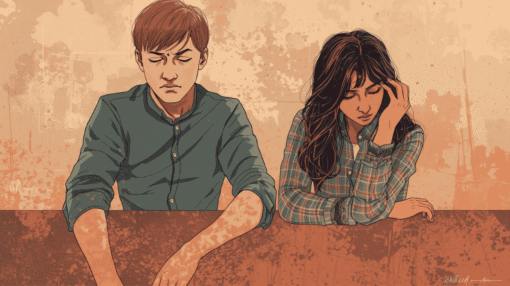
The Moment Everything Shifted
You’re scrolling through your phone when you notice something: your friend replied to your message three hours ago. Three hours. You sent it immediately after work, and they took three hours to respond.
Your stomach tightens.
You replay the last conversation. Did you say something wrong? Were they distant? Actually, yes—they were quieter than usual on that video call last week. And come to think of it, they’ve been canceling plans more often lately. They said it was work stress, but what if…
What if they don’t trust you?
What if they’re slowly pulling away because something you did—something you can’t even remember—broke their faith in you?
By evening, you’ve constructed an entire narrative: your friend is losing trust, they’re withdrawing, the friendship is crumbling. You decide to give them space. You don’t text as much. When they do reach out, you’re a bit distant back, protecting yourself from the inevitable rejection.
A week later, they message: “Hey, have I done something? You’ve been weird with me.”
And just like that, the thing you feared most has become real.
If this resonates with you, you’re not alone—and you’re not broken. Understanding how to rebuild trust after it’s been broken starts with recognizing the pattern you’re caught in.

Here’s the Truth Most Articles Won’t Tell You
Your friend probably isn’t losing trust in you.
But your anxiety about whether they trust you might actually be creating the very distance you fear.
This isn’t about being paranoid or oversensitive. This is about how the human mind works—specifically, how anxiety filters every ambiguous social signal through a lens of fear, turning neutral behavior into “proof” of betrayal.
Most articles on this topic give you a checklist: “10 Signs Your Friend Doesn’t Trust You.” They list things like:
- They don’t share personal information
- They avoid eye contact
- They take time responding to messages
- They make excuses to cancel plans
But here’s what those articles miss: every single one of those behaviors has 100 different possible explanations. And when you’re anxious about trust, your brain selects the explanation that confirms your fear.
This is called confirmation bias, and it’s one of the most destructive forces in friendships.
What Psychology Reveals: The Confirmation Bias Trap
Psychologist John Bowlby, who founded attachment theory, identified something profound: people with anxious attachment patterns are hypervigilant to signs of abandonment. Their nervous systems are calibrated to scan for threat.
This isn’t a character flaw. It’s usually rooted in early experiences where trust was inconsistent—a parent was sometimes available, sometimes withdrawn. A caregiver was emotionally unpredictable. The message was: you have to monitor for safety because it’s not guaranteed.
Fast forward to adulthood, and this nervous system response is still running.
The result? When your anxiously-attached brain encounters an ambiguous signal—a delayed text, a quieter tone, a canceled plan—your threat-detection system springs into action. Your mind doesn’t see a neutral event. It sees evidence.
“See?” your anxious nervous system says. “They’re pulling away. You can’t trust them. Protect yourself.”
Research on confirmation bias shows that once we form a hypothesis (in this case, “my friend is losing trust”), we unconsciously seek out information that confirms it. We notice the three-hour text delay but not the genuine laugh they gave at your joke. We remember the canceled plan but not the four plans they kept.
We’re not lying to ourselves. We’re selectively seeing a partial truth and believing it’s the whole picture.
Enter the Trust Verification Trap: The Four-Stage Self-Fulfilling Prophecy
This is where things get dangerous—and where most articles stop short of the real insight.
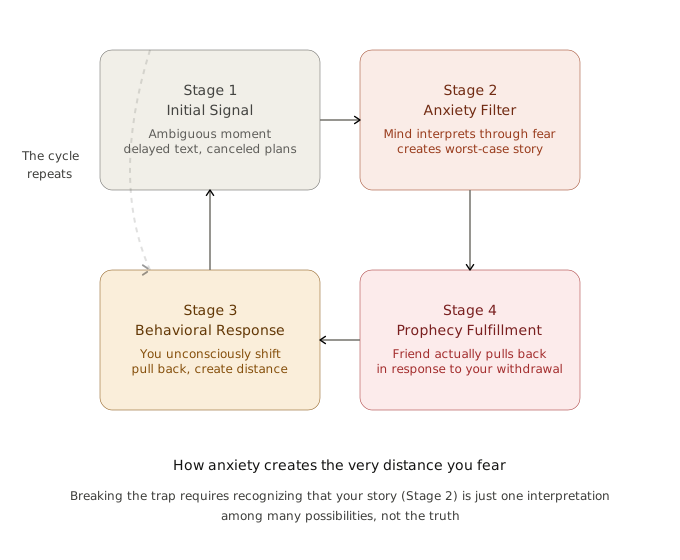
Here’s how anxiety about trust actually creates the distance you fear:
Stage 1: The Initial Signal
A genuinely ambiguous moment happens. Your friend:
- Takes longer to text back than usual
- Seems quieter in a group chat
- Cancels plans with a vague explanation
- Doesn’t share something personal like they used to
- Doesn’t make eye contact in conversation
This is information-neutral. It could mean anything. They could be stressed at work, dealing with family issues, going through a depressive episode, overwhelmed with other relationships, or simply tired.
But to an anxiously-attached nervous system, ambiguity feels dangerous.
Stage 2: The Anxiety Filter
Your mind doesn’t stay neutral. It runs the signal through your internal threat-detection system—which is primed by your attachment history.
If you’ve experienced betrayal before (and most people drawn to InMotivise have, given the focus on betrayal recovery), this filter is extra sensitive.
“That text delay? They’re angry with me.” “That canceled plan? They don’t want to be around me.” “That quietness? They’ve decided I’m not trustworthy.”
You’re not crazy. You’re anxious. And anxiety is a storyteller. It takes incomplete information and fills in the blanks with the worst-case scenario.
Research by psychologist Albert Ellis on cognitive distortions shows that anxious people engage in “catastrophizing” and “mind-reading”—assuming we know what someone else is thinking, and assuming the worst.
Stage 3: The Behavioral Response
Here’s where the trap closes.
Once you’ve decided your friend doesn’t trust you, you unconsciously shift your behavior. You:
- Text less frequently
- Share less personal information (since you believe they won’t care or you can’t trust them)
- Respond with slightly less warmth when they reach out
- Create distance—consciously or unconsciously—to protect yourself from rejection
- Become hyperaware of every interaction, looking for more evidence
You think you’re protecting yourself. What you’re actually doing is sending a signal: I’m pulling away from you too.
Stage 4: The Prophecy Fulfillment
Your friend, who was never actually pulling away, notices that you’re pulling away.
They don’t know about your anxiety spiral. They just notice:
- You’re responding less
- You seem distant
- You’re sharing less
- You’re available less
So they do what humans do: they reciprocate the energy you’re giving. They pull back a little too. Not because they don’t trust you, but because they’re responding to the withdrawal they feel from you.
And suddenly, the thing you feared most—the thing you were monitoring for, the thing you were sure was happening—becomes real.
You were right. Your friend is pulling away.
But the tragedy is: you created it.
Why This Happens: The Psychological and Spiritual Foundation
There are two layers to understand here.
The Psychological Layer:
Neuroscientist Stephen Porges’s Polyvagal Theory explains how our nervous system works. When we feel unsafe (emotionally, relationally), our nervous system activates what’s called the “social engagement system shutdown.” We literally become less available, more withdrawn, more guarded.
This isn’t conscious. It’s biological. Your body is trying to protect you.
But here’s the problem: in a friendship, this protection mechanism looks like rejection to the other person. And when they respond to your withdrawal by withdrawing themselves, your anxious brain says: “See? I was right. I can’t trust them.”
You’ve created a feedback loop. And the longer it runs, the harder it is to break.
The Spiritual Layer:
Many spiritual traditions point to something called the “law of attraction” or, in Hindu philosophy, karma—the principle that what you put out returns to you. While this is often misunderstood as purely mystical, there’s psychological truth here:
When you relate to someone from a place of fear and distrust, you create distance. You embody the very dynamic you fear. Your energy becomes what you’re afraid of.
This isn’t punishment. It’s causation. You’re not trusting the relationship, so you’re not showing up trustworthy. The other person feels that. They respond to it. And suddenly, the relationship mirrors back what you believed about it.
The Patterns That Emerge: Why Smart, Aware People Get Stuck Here
If you’ve done any personal growth work, you might recognize this pattern in yourself—and that can feel frustrating.
You know about attachment theory. You know about confirmation bias. You know that you tend toward anxiety. And yet, you still find yourself obsessing over whether your friend trusts you. You still catch yourself monitoring their responses. You still interpret delays as rejection.
This happens because knowing intellectually and feeling emotionally are two different nervous system states.
Intellectual knowledge lives in your prefrontal cortex—the logical brain. But anxiety lives in your amygdala—the threat-detection center. When your amygdala is activated, it doesn’t care what your prefrontal cortex knows. It cares about survival.
So you can be the most self-aware person on Earth and still get caught in the Trust Verification Trap. This isn’t weakness. It’s neurobiology.
The Intersection: How Attachment Wounds and Betrayal Trauma Interact
For people healing from betrayal—which is exactly who comes to InMotivise—this pattern is even more entrenched.
Betrayal trauma literally rewires your threat-detection system. When someone you trusted violated that trust, your nervous system learned: people cannot be trusted; relationships are dangerous; you need to be hyper-vigilant.
This is a rational response to a betrayal. The problem is that your nervous system doesn’t distinguish between:
- The person who actually betrayed you
- Every other person in your life
So now, every friendship carries the weight of past betrayals. Every ambiguous signal gets filtered through the lens of: “Will they hurt me too?”
This is why people who’ve experienced betrayal often struggle most with this pattern. It’s not that they’re more anxious by nature. It’s that they’ve been taught by experience that trust is dangerous.
Real Stories: How the Trap Manifests (And How People Break Free)
Case Study 1: The Over-Communicator
Sarah had been betrayed by a close friend five years ago—the friend spread a confidence and completely destroyed Sarah’s trust. Since then, Sarah had become hypervigilant in all her friendships.
Her friend Maya started a new demanding job. Maya, who usually texted daily, now texted a few times a week. She was stressed, busy, and honestly just didn’t have the emotional bandwidth for long conversations.
But Sarah’s betrayal-primed nervous system read it differently: She’s pulling away. She’s losing trust in me. I probably did something wrong, or she doesn’t value the friendship anymore.
Sarah started texting less. When Maya did reach out, Sarah was a bit short in her responses. She stopped sharing personal updates.
Six months later, Maya sent a text: “I feel like we’re not as close as we used to be. Did something happen?”
Sarah broke down. Because in trying to protect herself from anticipated rejection, she had created actual distance.
What shifted: Sarah had to do two things. First, she had to recognize that her interpretation was filtered through her past betrayal, not through reality. Second, she had to communicate directly: “I noticed you’ve been busier, and my anxious brain told me it meant you were pulling away from me. I realize now that I started pulling back too, which probably felt like rejection to you.”
The honesty itself—naming the pattern without defending it—actually rebuilt trust faster than any amount of monitoring ever could have.
Case Study 2: The Distant Processor
James’s friend Derek was introverted and processed emotions internally. After any conflict or heavy conversation, Derek needed time alone to think.
James, who was more extroverted and needed immediate discussion, interpreted Derek’s need for space as distrust. If he really valued our friendship, he’d want to talk this through right away, James thought.
James started pulling back, giving Derek the space he asked for—but with an edge of resentment underneath. He was punishing Derek (unconsciously) for what James perceived as emotional withdrawal.
Derek noticed. He felt judged. So he actually did start withdrawing—not because he didn’t trust James, but because the friendship no longer felt safe. He couldn’t be himself (introverted, processing-oriented) without James interpreting it as rejection.
What shifted: James had to learn that different attachment styles show trust differently. Derek’s need for processing space wasn’t distrust. It was just Derek. When James stopped interpreting it through his own needs, the friendship could actually deepen.

Breaking the Cycle: The Real Path Forward
If you recognize yourself in these patterns, here’s what actually works:
Step 1: Name the Pattern Without Shame
The first step isn’t fixing anything. It’s noticing.
“I’m in a Trust Verification Trap. I’m interpreting my friend’s ambiguous behavior through my anxiety. I’m probably about to pull back without realizing it.”
This isn’t self-criticism. It’s clarity. You’re not broken. Your nervous system is doing exactly what it was trained to do.
Step 2: Separate the Signal from Your Story
When you notice anxiety rising about your friend’s trust, practice this:
What actually happened: (Just the fact, nothing more)
- They took 2 hours to text back.
- They canceled plans.
- They didn’t ask about my week.
The story my anxiety tells: (What your brain says it means)
- They don’t care.
- They’re losing trust.
- I did something wrong.
What it could actually mean: (Other possibilities)
- They’re busy.
- They have their own stuff going on.
- They’re tired.
- They have a different communication style.
- They didn’t notice because they’re distracted.
You don’t have to believe the alternative explanations. You just have to acknowledge that your story is one possibility among many.
This small shift—from “they don’t trust me” to “I’m interpreting ambiguity through anxiety”—is where the trap starts to loosen.
When anxiety and uncertainty collide, write through your thoughts with prompts designed to help you separate facts from the stories your mind creates—this awareness is the first crack in the trap’s foundation.
Step 3: Communicate From Curiosity, Not Accusation
Here’s the key: Don’t communicate about the behavior itself. Communicate about your pattern.
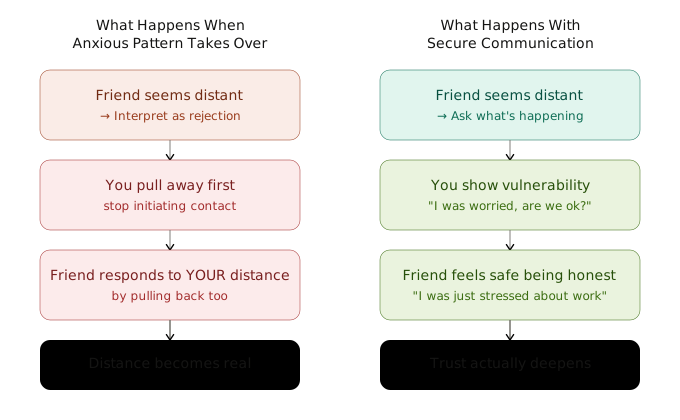
Instead of: “You’ve been distant lately. Do you not trust me?” (This puts them on the defensive and makes them feel accused.)
Try: “I’ve noticed I’m going into anxiety about whether you trust me. My past experience makes me sensitive to this. I wanted to check in—how are you actually feeling about our friendship? I might be misreading signals.”
This does three things:
- It owns your interpretation (not their behavior)
- It explains the root (your attachment history, not their fault)
- It invites real connection instead of creating defensiveness
When you do this, something remarkable happens: your friend usually softens. They understand. They feel seen rather than attacked. And in that moment, real trust actually builds—because you’ve shown vulnerability and self-awareness, not suspicion.
Step 4: Practice Secure Communication Patterns
Secure attachment isn’t about never feeling anxious. It’s about not letting anxiety drive your behavior.
When anxiety rises:
- Pause before responding
- Name what you’re feeling: “I’m feeling anxious right now”
- Ask instead of assume: “Are we okay?” instead of “You don’t trust me”
- Be direct instead of creating distance: “I’m working on my anxiety about this. Help me understand what’s actually happening”
The paradox is: when you communicate your vulnerability instead of your accusation, your friend actually wants to reassure you. The dynamic shifts from accusatory to collaborative.
Step 5: Rebuild Your Own Trust in Yourself
This is the deepest level.
Most of the people stuck in the Trust Verification Trap are people who’ve been betrayed. And betrayal damages your trust in yourself as much as in others.
You start asking: Why didn’t I see it coming? What’s wrong with my judgment? Can I trust myself to know who’s safe?
Rebuilding trust with your friend matters. But rebuilding trust in your own instincts matters more.
This means:
- Trusting that you can recognize when something is actually wrong (not everything is your anxiety)
- Believing that you’re capable of making good relationship decisions
- Knowing that past betrayal doesn’t mean future betrayal
Without this, you’ll keep cycling through the trap with different friends, because the root issue isn’t about them. It’s about your faith in yourself.
Integration & Long-Term Practice: Living Beyond the Trap
Breaking the Trust Verification Trap isn’t a one-time fix. It’s a practice.
Here’s what sustainable change looks like:
In the moment (when anxiety spikes):
- Notice: “I’m interpreting ambiguity through anxiety”
- Pause: Don’t text them while activated
- Breathe: Literally—your nervous system needs regulation
- Separate signal from story
- Wait for clarity before responding
In the relationship (ongoing):
- Communicate directly about your attachment patterns
- Ask clarifying questions instead of making assumptions
- Share your vulnerability, not your suspicion
- Notice when your friend is showing up for you (your anxiety brain filters these out)
- Celebrate security when it happens
In your personal work (the foundation):
- Work with attachment theory to understand your history
- Heal betrayal wounds (journaling, therapy, community)
- Build self-trust through consistent self-care
- Practice mindfulness to notice anxiety without acting on it
- Remember: your nervous system learned this for a reason. Be compassionate with it.
Over weeks and months, monitor the gradual shifts in how you interpret ambiguous moments—watch as patterns that felt immovable begin to dissolve. Progress isn’t linear, but it’s real.
Realistic timeline: This isn’t a 30-day fix. Nervous system patterns developed over years rewire over months and years. You’ll have breakthroughs and setbacks. That’s normal. That’s human. That’s actually progress.
What People Get Wrong (Common Misconceptions)
Misconception 1: “If my friend trusted me, I’d feel it”
Reality: Trust isn’t a feeling you receive from someone else. It’s something you build through consistent, secure behavior. You might feel distrust based on your anxiety, even when your friend trusts you completely. And that’s the whole problem.
Misconception 2: “I can read people well—if I feel like they don’t trust me, they probably don’t”
Reality: You can read people. But anxiety distorts the reading. Especially if your attachment history taught you to scan for threat. Trust your instincts about whether someone is safe long-term. But don’t trust your real-time anxiety interpretations about whether someone is pulling away.
Misconception 3: “I just need to be more careful about who I trust”
Reality: You probably don’t need a better person-selection process. You need a better regulation process. Because you’ll likely cycle into this pattern with safe people too, until you address your nervous system’s threat-detection sensitivity.
Misconception 4: “Trust issues are something my friend needs to fix”
Reality: If you keep interpreting ambiguity as rejection, that’s your nervous system’s pattern to address—not your friend’s fault. They’re not failing to reassure you enough; you’re failing to receive reassurance because your threat-detection is too high.
Misconception 5: “If I just give them enough space, they’ll prove they trust me”
Reality: Creating distance doesn’t build trust. It creates actual distance. Secure relationships are built through appropriate vulnerability and consistent presence—not through withdrawal and testing.
FAQ: The Questions People Actually Ask
Q1: How do I know if my friend actually doesn’t trust me vs. my anxiety misreading the situation?
A: Real distrust shows up consistently over time with evidence of behavior change toward you—they share less with you specifically, they make less effort with you specifically, they act differently around you specifically.
Anxiety creates a story based on one or two ambiguous signals filtered through your fear.
The difference: Real distrust changes the pattern. Anxiety interprets one instance through old patterns.
Before you accept “my friend doesn’t trust me,” ask: Is there actual consistent behavior change toward me? Or am I interpreting isolated moments through my anxiety?
Q2: What if my friend actually IS pulling away? How do I know if I caused it or if it’s real?
A: First, communicate directly. No mind-reading. “I’ve noticed we’re not as connected as we used to be. What’s happening on your end?”
If they say they’re busy/stressed/dealing with something—that’s information, not rejection.
If they say something like “I felt judged by you” or “I didn’t feel safe in our friendship”—that’s real information to work with.
Then ask: Did I create this distance through my behavior (pulling back, testing, becoming distant)? Or did something else create it?
Only you can know if you were the catalyst. But here’s the truth: if you were the catalyst, acknowledging it and changing your behavior usually fixes it.
Q3: Can I rebuild a friendship if I’ve already been anxious and distant in it?
A: Yes. Absolutely. But it requires naming what happened.
“I realize I’ve been distant with you, and I want to be honest about why. I was anxious about whether you trusted me, so I pulled back without realizing it. I want to rebuild this.”
That honesty itself rebuilds trust faster than any amount of normal friendship behavior.
Your friend will likely recognize the pattern too. They’ll probably feel relief that you named it.
Q4: What if I keep cycling through this with multiple friends? Is the pattern just me?
A: Yes—the pattern is your nervous system’s response to betrayal or attachment history. It’s not about your friends being untrustworthy or you being broken.
But it means you need to do deeper work on your attachment style and past betrayals, not just relationship-by-relationship fixes.
This is where a coach, therapist, or serious personal growth work becomes valuable. The pattern persists until the root nervous system response shifts.
Q5: How do I build genuinely secure friendships if I have anxious attachment?
A: You don’t wait until you’re “fixed” to have good friendships. You have them while you’re working on yourself.
Secure attachment in friendship looks like:
- Naming your patterns when they come up (“I’m feeling anxious right now”)
- Being direct instead of testing
- Trusting your friend’s words unless their behavior proves otherwise
- Believing their good intentions until proven wrong
- Sharing your vulnerability, not your suspicion
Your friends don’t need you to be secure. They need you to be honest about your insecurity.
Q6: Is it possible to have betrayal trauma and still have secure friendships?
A: Absolutely. Healing from betrayal doesn’t mean forgetting it happened. It means integrating it without letting it run every relationship.
A securely-attached person with betrayal history can say: “I was hurt before, and now I’m careful about trust. But I’m not assuming you’ll hurt me. I’m watching how you show up consistently, and I’m healing my own nervous system at the same time.”
That’s not anxious. That’s wise.
Conclusion: The Paradox of Trust
Here’s what most friendship advice gets backward:
People think: If I can just read the signs correctly, I can protect myself from betrayal.
Reality: The more you focus on reading signs, the more you create the betrayal you’re afraid of.
The irony is this: Trust isn’t built by becoming a better interpreter of signals. It’s built by becoming someone willing to be vulnerable despite the risk.
When you stop obsessing over whether your friend trusts you and start asking “Am I being trustworthy? Am I showing up with integrity? Am I communicating from honesty instead of fear?”—everything changes.
Your friend doesn’t need you to read them correctly. They need you to trust them. And the way you show trust isn’t by analyzing their behavior. It’s by being reliably present, honestly vulnerable, and willing to ask questions instead of making accusations.
If you’ve experienced betrayal—and if you’re drawn to this content, you likely have—your nervous system learned to protect itself through vigilance. That was smart. That probably saved you from further harm.
But now, it might be protecting you so much that it’s actually keeping you isolated.
The path forward isn’t becoming better at reading signals. It’s becoming brave enough to trust despite your history.
That’s harder. But it’s also what actually builds the secure friendships you’re looking for.
Reflection Prompt
Before you leave, sit with this question:
In which friendships have I been caught in the Trust Verification Trap? What anxiety was I interpreting as a sign of distrust? And what might I learn if I communicated directly instead of pulling away?
You might even journal this or discuss it with a trusted person. Because awareness is where change begins.
Research References
Attachment Theory & Early Development:
Bowlby, J. (1969/1982). Attachment and Loss: Vol. 1. Attachment. Basic Books.
- https://www.simplypsychology.org/bowlby.html
- https://www.tandfonline.com/doi/full/10.1080/14616734.2025.2550829
Bretherton, I. (1992). The origins of attachment theory: John Bowlby and Mary Ainsworth. Developmental Psychology, 28(5), 759–775.
Confirmation Bias Research:
Confirmation bias overview: https://www.britannica.com/science/confirmation-bias
Neural mechanisms of confirmation bias:
- https://www.ncbi.nlm.nih.gov/pmc/articles/PMC12198416/
- https://www.ncbi.nlm.nih.gov/pmc/articles/PMC7250867/
Active sampling and confirmation bias:
- https://www.ncbi.nlm.nih.gov/pmc/articles/PMC9038198/
Nervous System & Polyvagal Theory:
Porges, S. W. (2009). “The polyvagal theory: New insights into adaptive reactions of the autonomic nervous system.” Cleveland Clinic Journal of Medicine, 76(4), S86-S90.
- https://www.ccjm.org/content/76/4_suppl_2/S86
Porges, S. W. (2022). “Polyvagal Theory: A Science of Safety.” Frontiers in Integrative Neuroscience, 16, 871227.
- https://www.ncbi.nlm.nih.gov/pmc/articles/PMC9131189/
Porges, S. W. (2021). “Polyvagal Theory: A biobehavioral journey to sociality.” Comprehensive Psychiatry and Neuroscience, 100069.
- https://www.ncbi.nlm.nih.gov/pmc/articles/PMC9216697/
Relationship Psychology & Trust:
Lerner, H. (2017). Why Won’t You Apologize?: Healing Big Betrayals and Everyday Hurts. Simon & Schuster.
- https://www.harrietlerner.com/
- https://www.psychologytoday.com/us/contributors/harriet-lerner-phd