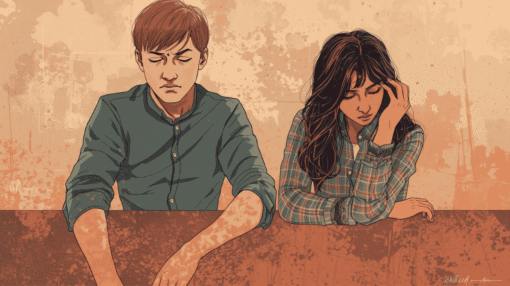
When You Can’t Stop Replaying It
You keep going back to the moment you found out. Or the moment something felt off but you ignored it. Or the moment they looked you in the eye and lied. You replay it, analyze it, try to extract some answer from it that will make it all make sense.
It won’t. Not yet. And that’s not a failure of your mind — it’s the natural response of a nervous system that has experienced a real psychological shock. Betrayal by someone you loved and trusted doesn’t just wound emotionally. It disrupts your entire sense of safety in the world.
But here’s what no one tells you enough: you don’t have to figure it all out to begin healing. You don’t have to understand why they did it. You don’t have to wait for an apology, or for karma to visibly strike them down, to give yourself permission to start recovering. Healing isn’t a reward you get after understanding the betrayal. It’s a decision you make in spite of it.
What Betrayal Actually Does to Your Brain and Body
Before we talk about karma or moving forward, let’s talk about what’s actually happening inside you — because understanding it changes how you treat yourself.
Betrayal activates the same neural pathways as physical pain. Research in neuroscience has shown that social rejection and emotional betrayal light up the same regions of the brain as a broken arm. This is why it physically hurts. Why you feel it in your chest. Why you can’t eat, or sleep, or stop your hands from trembling when you see their name.
Your body is also flooded with cortisol — the stress hormone — which keeps you in a hypervigilant state. You become hyperaware of danger signals in future relationships. You flinch at things that shouldn’t matter. Your fight-or-flight system is working overtime, not because you’re weak, but because your brain is trying to protect you from ever being that blindsided again.
Knowing this changes how you heal. You’re not overreacting. You’re not “too sensitive.” You are biologically and psychologically responding to a genuine wound. The goal isn’t to suppress that response — it’s to guide your nervous system back to safety, one day at a time.
The Grief Nobody Warns You About
Healing from cheating involves grief — but it’s a layered, complicated kind of grief that doesn’t follow a clean timeline. You’re not just grieving the relationship. You’re grieving:
The version of them you believed in. The person they appeared to be. The relationship you thought you had. All of that existed in your mind as real — and it’s been forcibly corrected. That loss is profound.
Your own sense of judgment. One of the quietest wounds of betrayal is the voice that asks, How did I not see it? You trusted your instincts and they seemed to fail you. Rebuilding confidence in your own perception is often the longest part of recovery.
The future you imagined. Every couple, consciously or not, builds a mental picture of what’s ahead. That picture is gone now. Grieving an imagined future is just as real as grieving something you actually lost.
Your sense of safety in love. Perhaps most painfully, betrayal wounds your ability to feel safe being open with another person. And that, more than anything else, is what takes time to rebuild.
Give each of these layers their due. Don’t rush past any of them. The people who seem to heal fastest are often the ones who gave themselves full permission to feel everything — instead of jumping straight into distraction, anger, or a new relationship.
Why Letting Karma Work Is Not Passive — It’s Strategic
There’s a version of “letting karma do its work” that looks like resignation — just sitting back, wallowing, and hoping something bad happens to them. That’s not what this is.
Letting karma work is a strategic reallocation of your energy. Here’s the truth: the mental bandwidth you spend obsessing over their consequences — checking their social media, hoping their new relationship falls apart, waiting for the universe to punish them visibly — is bandwidth stolen from your own recovery.
Every hour you spend monitoring their life is an hour you are not rebuilding yours.
Karma is already working. It doesn’t need your supervision. The emotional consequences of betrayal — the guilt, the distorted ability to trust, the spiritual emptiness that follows dishonesty — are already operating inside the person who hurt you. You may never see it. You probably won’t be invited to witness it. But it is happening.
Your job is not to watch. Your job is to rebuild.
Continue reading: Karma for Cheaters: The Hidden Emotional and Spiritual Price of Betrayal

The Practical Work of Healing: What It Actually Looks Like
Healing isn’t an epiphany. It’s a series of small, unglamorous choices made repeatedly over weeks and months.
Stop the exposure loop. Unfollow them. Mute them. Remove their number from your favorites. This isn’t about hatred — it’s about not feeding the wound. Every time you check on them, your nervous system re-registers loss. You cannot heal a cut while you keep reopening it.
Rebuild a daily anchor. When your sense of stability has been shaken, routine is medicine. Not exciting new adventures — a quiet, consistent routine that signals to your body: you are safe, you are here, today has structure. A morning walk. A regular meal. A journal entry before bed. These small anchors matter more than people realize.
Rebuild your identity apart from the relationship. Many people, especially in long-term relationships, quietly absorb their partner’s preferences, social circles, and rhythms. After betrayal, this leaves an identity vacuum. Fill it deliberately. What did you love before them? What interests got quietly shelved? What friendships faded? Begin reclaiming those things — not dramatically, but one at a time.
Let anger be useful, not consuming. Anger after betrayal is healthy and appropriate. It’s your psyche setting a boundary: what happened to me was not okay. But unchecked, anger becomes a way of staying attached. It keeps them at the center of your emotional life. Channel it — into exercise, into creative work, into decisive action in your own life — rather than letting it simmer into obsession.
Talk to someone who won’t just validate you. Friends are essential, but what you also need is someone — a therapist, a counselor, a trusted mentor — who will help you process without simply fueling your anger or telling you what you want to hear. You need perspective, not just agreement.
The Quiet Signs That You’re Actually Healing
Healing doesn’t usually arrive like a sunrise. It comes in whispers — and if you’re not watching for them, you’ll miss them.
You’re healing when you go an entire morning without thinking about them. You’re healing when a song that used to gut you plays and you feel… mostly okay. You’re healing when you catch yourself making plans for the future without the weight of the betrayal attached. You’re healing when you feel curiosity about life again, not just pain.
You’re healing when you stop wanting them to hurt — and just want yourself to be okay.
That shift — from wanting justice to wanting peace — is one of the clearest signs that karma has been handed its work, and you have picked up yours.
What Karma Is Actually Doing While You Heal
Karma is not a delayed punishment. It’s the natural consequence of living out of alignment with truth, love, and integrity. For the person who betrayed you, that misalignment doesn’t disappear when the relationship ends. It follows them. It shows up in their difficulty trusting others. In the relationships that keep falling apart for reasons they can’t quite name. In the quiet moments when everything is fine but something still feels hollow.
You don’t need to see any of this to know it’s true. And you don’t need it to happen dramatically for justice to be real.
Meanwhile, what karma is doing for you — for the one who loved honestly — is something entirely different. It’s building. Every day you choose healing over revenge, you are accumulating something: clarity, self-respect, genuine strength. The universe has a way of recognizing people who keep their integrity intact under pressure. What comes to them is not a reward, exactly — it’s more like an alignment. Things begin to make sense again. The right people appear. Opportunities arrive that would have been impossible in the relationship you left behind.
That’s karma too. Just yours.
Moving Forward Without Needing the Last Word
Many people stall their healing waiting for one final conversation — a confession, an apology, an acknowledgment that what happened was wrong. And sometimes that conversation never comes. Sometimes the person who hurt you most profoundly never admits it, never regrets it publicly, never gives you the closure you deserved.
Here’s what you need to hear: you can heal completely without it.
Closure is something you create internally, not something they hand you. It happens the day you decide that your healing is no longer dependent on their accountability. That your peace doesn’t require their participation. That you are done waiting for permission from the person who already took so much from you.
You don’t need the last word. You need your next chapter.
Let karma handle the ending to their story. You have your own story to write — and from here, it only gets more yours.
Also explore: Moving On After Betrayal